
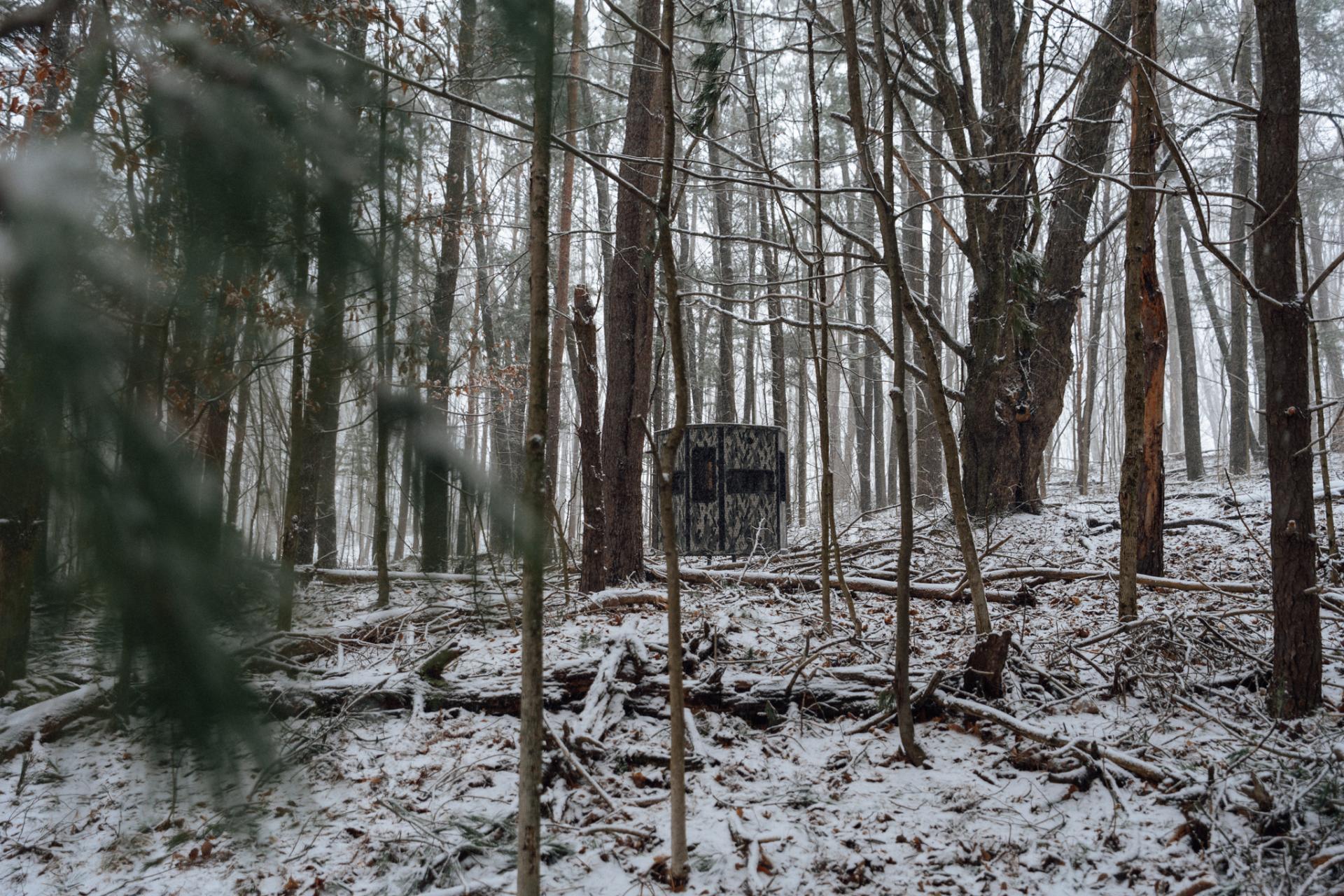
Cold ends more hunts than slow deer movement ever will. You take the week off, the temperature drops overnight, and by nine in the morning your hands are too stiff to work a safety. So you climb down early, and that's a morning of your season gone.
A heater can keep you in the blind through the best part of the day. But a heater in a small, sealed space has to be done right. Here's how to heat a hunting blind so you stay warm, stay hidden, and stay safe.
Start with the blind, not the heater
The best heat is the heat you never lose. A thin pop-up or an uninsulated plywood box leaks warmth through every wall, the roof and the floor, so your heater runs flat out just to keep up.
Every Orion blind is built with HuntShield360 panels: 2" of R11 foam in every panel, the floor and roof included, not just the walls. Cold doesn't creep up through your boots, and warm air doesn't escape through the ceiling. In an insulated blind, a small heater on its low setting goes a long way, and on many mornings your own body heat and good layers are enough.
Insulation also helps in warm country. The same panels that hold heat in during a Michigan November keep the sun's heat out during a Texas October.
Choose a heater that's made for enclosed spaces
This is the part that matters most. Not every portable heater belongs inside a blind.
- Use only a heater rated for indoor use. Look for an indoor-safe label on the box and in the manual.
- Look for an oxygen depletion sensor (ODS). It shuts the heater off automatically if the oxygen level in the blind starts to drop.
- Look for tip-over protection. It shuts the heater off if it gets knocked over by a boot, a pack or a dog.
- Never bring an outdoor-only heater inside. That includes tank-top heaters and anything labeled for outdoor use. They burn more fuel and put out more carbon monoxide than an enclosed space can handle, even for a few minutes.
- Bigger isn't better. In an insulated blind, a small portable heater is plenty. A heater that's too big turns the blind into a sauna, fogs your windows and burns through fuel.
Prefer no flame at all? A battery-powered or electric heat source, run off a portable power station, is another option. Heated seat pads and heated clothing put the warmth exactly where you need it.
Tips to set it up
A good heater still needs a good setup. A few habits make all the difference.
- Bring a battery-powered carbon monoxide alarm. It's cheap and it weighs almost nothing. Carbon monoxide has no smell and no color. The alarm is the only warning you'll get.
- Leave your vents uncovered. Every Orion blind comes standard with three 4" louvered vents that stay open all the time, bringing fresh air in and letting combustion air and moisture out. Some hunters cover them to keep their scent in the blind. With a heater running, never cover them.
- Give the heater room. Set it on the flat floor, away from walls, windows, chairs, packs and clothing. Follow the clearances in your heater's manual. Orion blinds are carpeted floor to ceiling with SoundShield360 blackout carpet, so keep the heater's hot face pointed into open space, not at a wall.
- Keep the big tank outside. If your heater runs off a bulk propane tank, leave the tank outside the blind and run the hose in. The standard Orion door has a pass-through port for a heater hose or power cord, so you can close the door tight around it.
- Check your hose before the season. Look over the hose and fittings for cracks or wear at home, before opening day. Brush a little soapy water on the fittings, and if you see bubbles, replace the part. In the field, if you ever smell propane, shut the heater off and air out the blind.
- Turn it off when you leave. Never leave a heater running in an empty blind, and never fall asleep with it on.
- Know the warning signs. A headache, dizziness, nausea or unusual sleepiness can mean carbon monoxide. Shut the heater off, open the door and get outside right away.
Hunting from an Orion blind with the ADA door? The ADA door trades the pass-through port for a zero-threshold entry, so a wheelchair rolls straight in. Use a heater designed to run on small cylinders inside the blind, or go electric, and keep those vents uncovered.
Watch the windows and your scent
When you first heat a blind on a cold morning, expect moisture on the inside of the windows. That's normal. Carry a microfiber towel and wipe the glass when it fogs. As the blind comes up to temperature and the air inside dries out, the windows clear up on their own. Many hunters warm the blind up when they first settle in, then turn the heater down once the blind holds its heat.
Heat also moves air, and moving air carries scent. Orion blinds use ScentShield360 gaskets on every seam to help hold your scent in, and the vents are small enough that you don't need to cover them. Some hunters do anyway, but never cover them while a heater is running. Play the wind like you would anywhere else, and set up so it carries your scent away from where you expect deer to come from.
Stay warm before you ever light it
The heater is the last line, not the first. Get these right and you'll need a lot less heat.
- Walk in cool, then layer up. Sweat on the walk in turns into a chill an hour later. Carry your heavy layers and put them on in the blind.
- Keep your feet off the cold. Insulated boots and dry socks matter more than anything else. An insulated blind floor helps a lot too.
- Cover your head and hands. A warm hat and a hand muff with a couple of hand warmers inside will carry you through a long sit.
- Eat and drink. Your body makes heat from fuel. A thermos of something warm and a snack mid-morning go a long way.
- Get out of the wind. Wind steals more heat than temperature does. Closed windows and sealed seams keep it outside.
Questions hunters ask
Is it safe to use a propane heater in a hunting blind?
Yes, with the right heater and the right setup. Use a heater rated for indoor use with an oxygen depletion sensor and tip-over shutoff, keep the vents uncovered, give it clearance from walls and gear, and bring a battery-powered carbon monoxide alarm. Never use an outdoor-only heater inside a blind.
How big a heater do I need?
Smaller than you'd think, especially in an insulated blind. A small portable heater on its low setting is usually enough, and it saves fuel and keeps your windows clear.
Do I really need a carbon monoxide alarm?
Yes. Carbon monoxide can't be seen or smelled. A battery-powered alarm is inexpensive, and it's the only warning you'll get.
Can I run a heater hose into an Orion blind?
Yes. The standard Orion door has a pass-through port for a heater hose or power cord. Blinds with the ADA door don't have the port, so use a heater that runs on small cylinders inside the blind, or an electric heat source.
Built for the cold
An Orion blind gives you a head start before the heater ever comes on: R11 insulation in every panel, sealed seams, tinted windows and three standard vents. Not sure which size fits your crew? Compare all six Orion blinds side by side, or shop Orion blinds.
Always follow your heater manufacturer's instructions and safety warnings.