
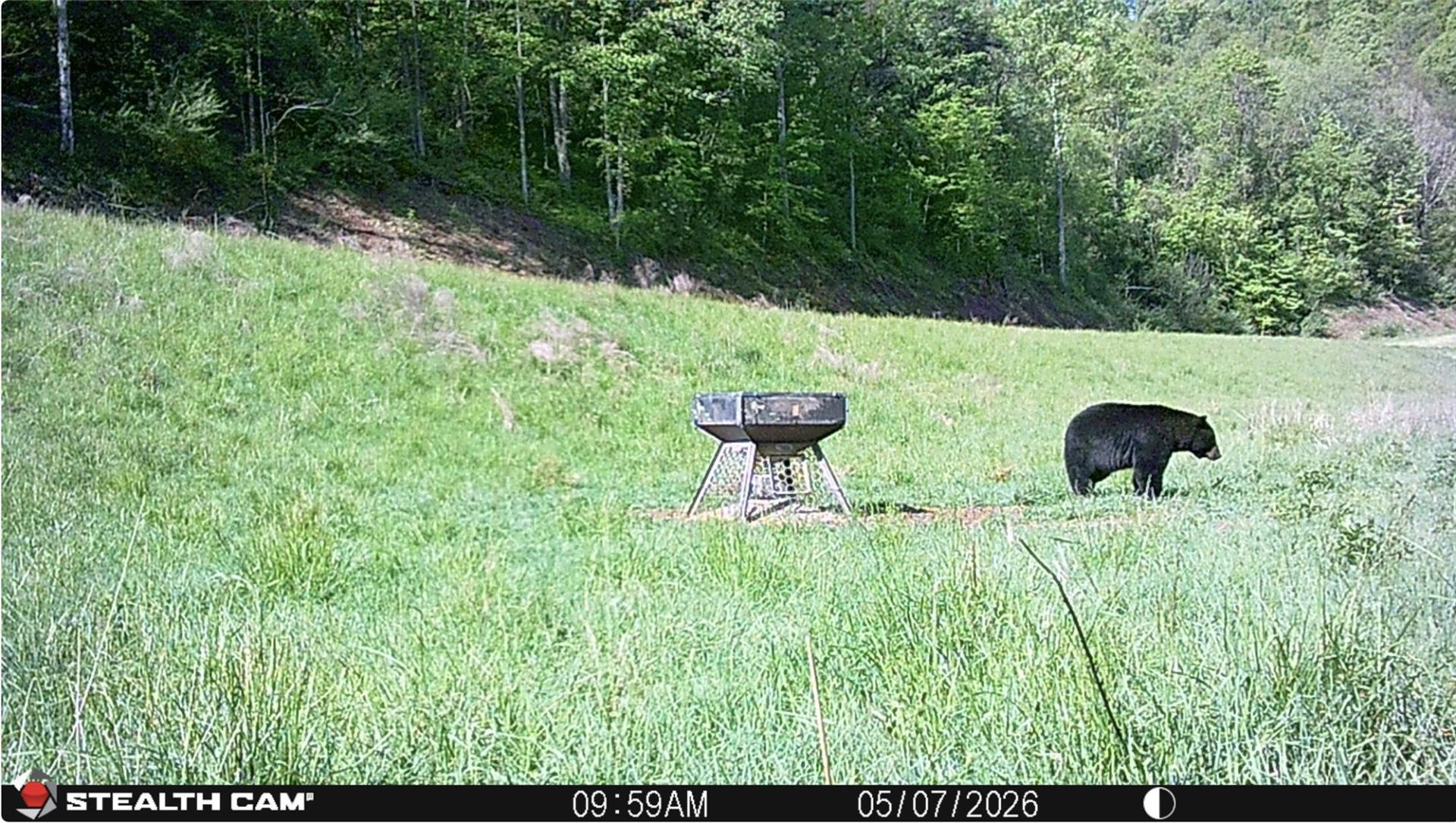
You pull the card from your trail camera expecting a buck. Instead you get a sow and two cubs, and the next morning every kernel of corn has disappeared. If you hunt anywhere bears live, this story is familiar. Corn is easy calories, and a deer feeder is a big, obvious source of it.
You can't make a feeder invisible to bears. But you can make it a feeder they can't get into, can't tip over and can't drag off. Here's how to keep bears off your deer feeder, and what to do when they show up anyway.
Why bears go after deer feeders
Bears are built to find food and remember where they found it. They hit feeders hardest at two times of year. In early summer, after the spring greens fade and before the berries ripen, natural food runs thin. In late summer and fall, bears go into a feeding binge before the den, eating as much as 15,000 to 20,000 calories a day. Both overlap with when most hunters are running feeders.
Once a bear learns a feeder pays off, it comes back. That's why the first visit matters most. A feeder that gives up a full hopper teaches the bear to keep trying. A feeder that gives up nothing but what's already on the ground teaches it to move on.
What a bear does to a feeder
Most feeder damage comes down to three things:
- Tipping it over. Cheap tripod feeders on tall, spindly legs go over easily, whether it's a bear, a hog rooting underneath or just a curious animal. Once a feeder is on its side, the hopper empties onto the ground.
- Tearing into it. Plastic barrels, thin sheet metal and exposed spinner housings don't stand up to a determined bear.
- Dragging it off. A hungry, food-aggressive bear that can't get in may try to drag the whole feeder off.
Stop all three, and a bear gets nothing but the feed the spinner has already thrown.
How to bear-proof a deer feeder
1. Start with a feeder that can't be tipped or torn open
Look for steel, not plastic, around the hopper and the spinner. Look for a low, wide stance rather than tall tripod legs, so hogs rooting underneath and other curious animals can't knock it over. A feeder that stays upright and can't be chewed through takes away most of the reward before you do anything else.
2. Anchor it to the ground
A hungry, food-aggressive bear can tip over or drag off even a heavy feeder. Ground anchors at each corner keep it standing and keep it where you put it. In bear country, anchoring isn't optional. It's the difference between a feeder that takes a beating and one you find fifty yards downhill.
3. Keep the ground clean
Leftover corn on the ground pulls bears in. Set your timer so the feeder throws about what your deer clean up, not more. If you see corn building up under the feeder, cut back the amount or the number of feedings.
4. Skip the sweet stuff
Plain corn and soybeans work well in a feeder. Sweetened feeds, molasses-coated mixes and scent attractants draw bears from a long way off. If bears are a problem on your ground, keep your feed plain.
5. Watch it with a trail camera
A camera on your feeder tells you when bears show up, how often and at what time of day. That's the information you need to decide whether to adjust your timer, pause feeding or move the feeder.
6. Time your response to the season
In late spring and early summer, if a bear is hitting your feeder hard, shut it off for two to three weeks. With no food reward, most bears move on, and your deer have plenty of natural food that time of year. Be patient: early summer is when natural food is scarcest for bears, so a determined one may take the full stretch to give up.
Late summer and fall are different. Bears are fattening up for the den, and so are your deer. A steady fall food source helps does build the fat reserves they need to carry fawns through the winter, which supports fawn survival in the spring. It also gives bucks a reliable place to refuel before, during and after the rut, when they can lose 10 to 30 percent of their body weight. Shutting the feeder off isn't really an option then. That's when the rest of this list matters most: an anchored feeder a bear can't tip or open, a timer set to throw only what your deer clean up, and plain feed.
It's also worth knowing your state's rules on running a deer feeder and hunting over one. Check with your state wildlife agency before you set up.
What a bear taught us
In April 2025, a customer's trail camera caught a black bear working on one of our feeders through the night. The first thing to go was the trim. Back then we dressed up our feeders with aluminum camo panels, the same skin we put on our blinds, and the bear peeled them right off. Eventually it got into the feeder.
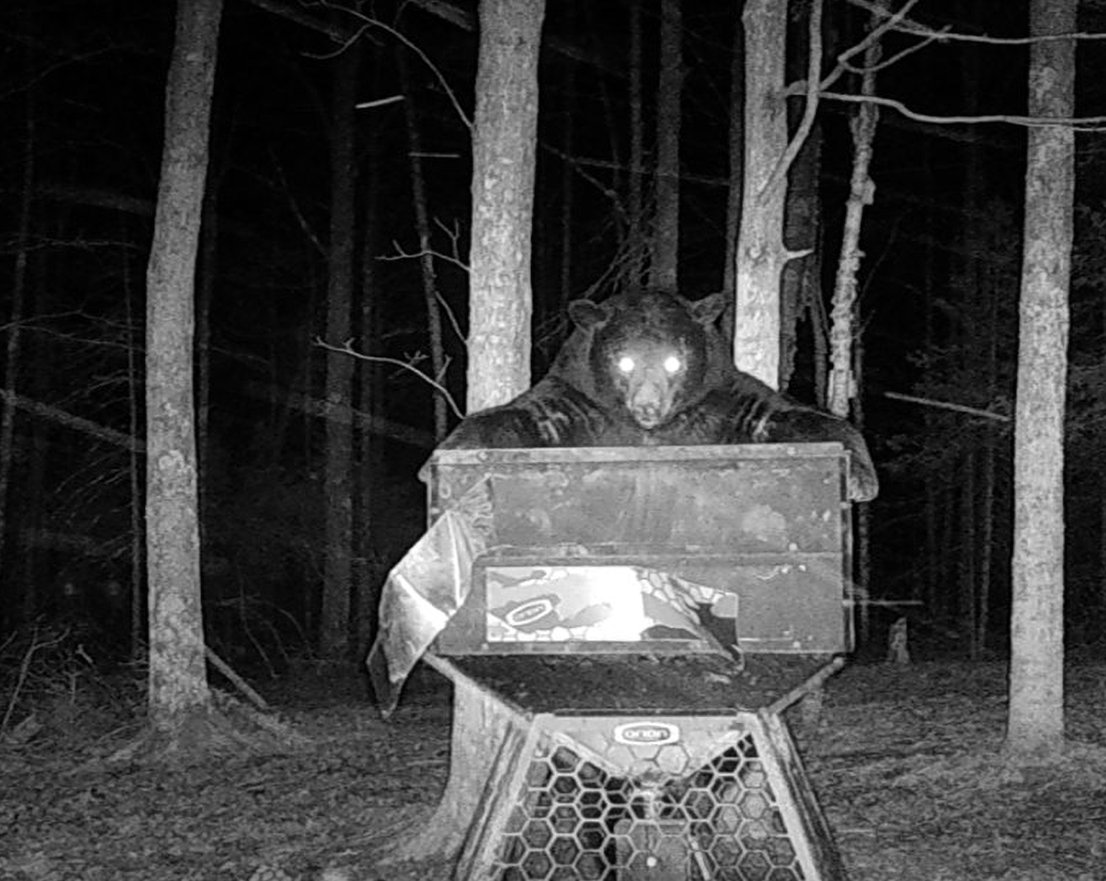
April 2025: the camo panels were the first thing to go.
We went through the footage, figured out how the feeder failed, and revised the design to close that gap. Then we sent the customer a new, improved feeder.
One change you can see: the aluminum camo is gone. Our feeders now get decals instead. They don't look quite as sharp, but they hold up better when a bear works on the feeder, and they're one less thing for a bear to fixate on. If one does get damaged, a decal is easy to replace. That's how we build everything. Find the weak point, fix it, and stand behind the result.
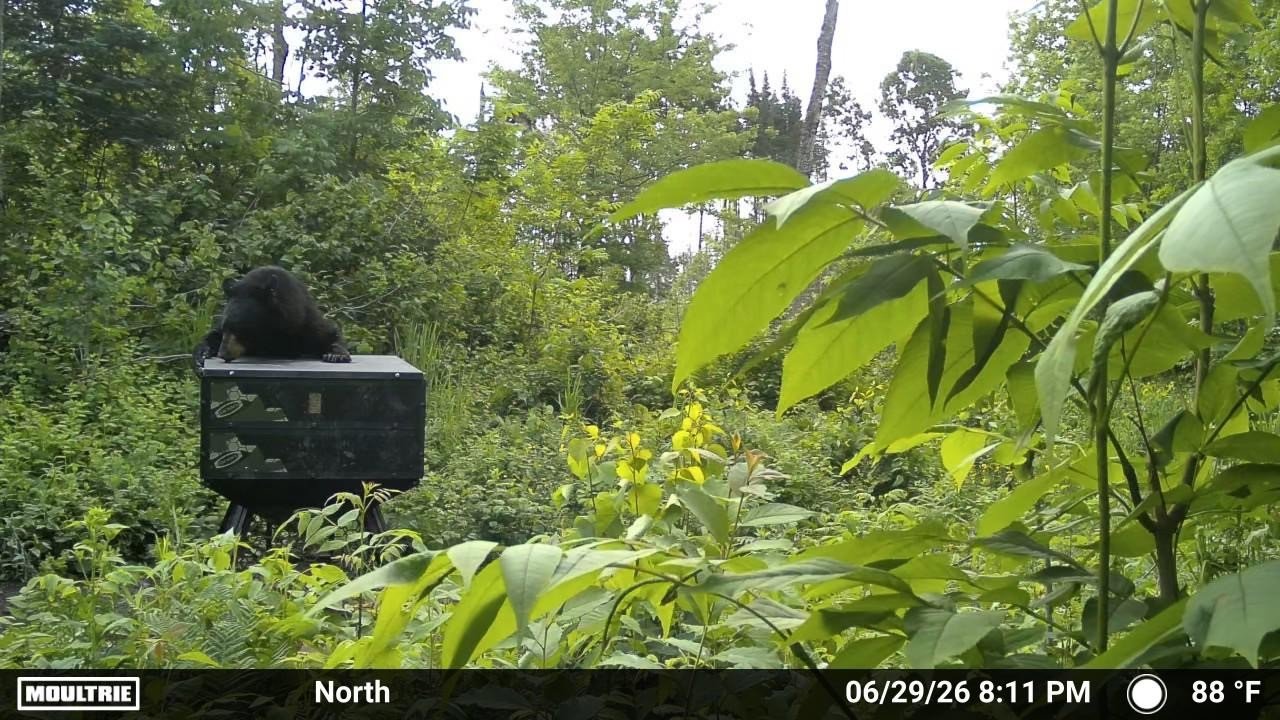
June 2026: A bear checks out a new Orion feeder.
How Orion builds a bear-proof feeder
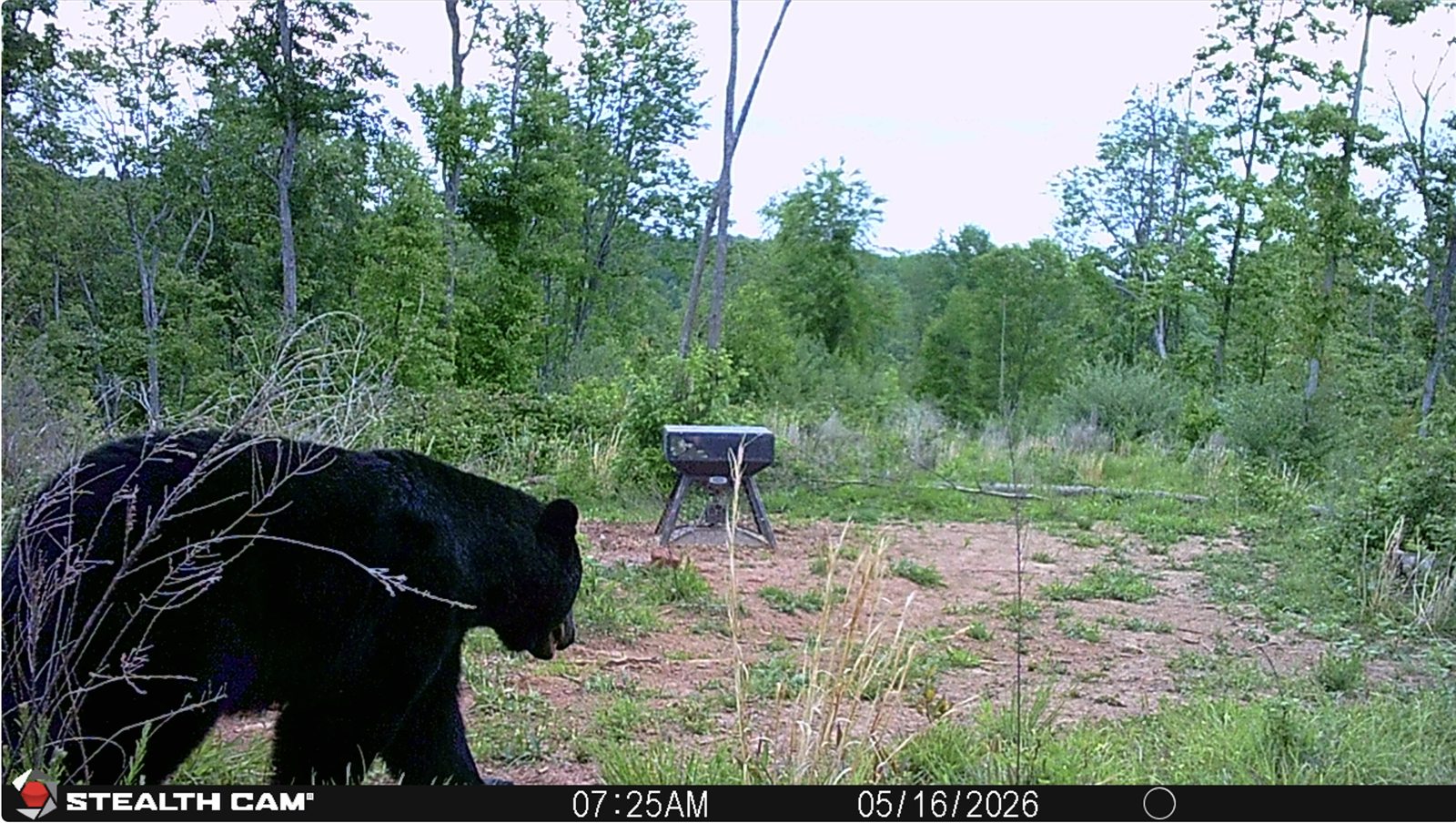
Orion feeders are built in Iron Mountain, in Michigan's Upper Peninsula, which is bear country. We designed them around those three failure points.
- Can't tear in. The hopper is powder-coated 16-gauge steel on a hexagonal base cage that keeps bears and hogs out.
- Hard to knock over. A low profile and a wide stance, so hogs rooting underneath and other curious animals can't tip it the way they tip a tripod feeder.
- Stays put, even with a bear on it. The MAX Anchor Kit keeps a hungry, food-aggressive bear from tipping the feeder over or dragging it off: four 30" pound-in earth anchors, each rated for 800 lbs of pull-out force.
- Varmints get what's thrown, not what's stored. The Eliminator spinner plate and base cage keep raccoons and squirrels out of the hopper too.
And we put it in writing. Anchor your feeder with the MAX Anchor Kit, and Orion guarantees it against bear and hog damage that disables it for 12 months from purchase. If it happens, send us photos and we'll sort out the replacement parts. That's on top of the 10-year limited warranty against defects.
Questions hunters ask
Will a bear-proof feeder keep bears away completely?
No feeder will. A bear-proof feeder keeps bears out of the hopper and keeps them from tipping or dragging it. A bear can still eat corn that's already on the ground, which is why it pays to keep spill to a minimum.
Do I really need ground anchors?
In bear country, yes. The anchors keep a hungry, food-aggressive bear from tipping the feeder over or dragging it off. On an Orion feeder, the MAX Anchor Kit is also the one condition of the 12-month Bear/Hog Proof Guarantee. At $57, order it with the feeder rather than after the first incident.
Does the same setup work for hogs?
Yes. Hogs root underneath and push rather than climb. The wide stance and low profile keep them from tipping the feeder, and the steel cage keeps them out of the hopper. Orion's guarantee covers hog damage as well as bears.
Is it legal to hunt over a deer feeder?
It depends on your state, and sometimes your county. Some states allow hunting over a feeder, some allow feeding deer but not hunting over it, and some don't allow feeding at all. Many hunters also run feeders outside the season to support herd health, which is legal in many places where hunting over feed is not. Check with your state wildlife agency before you set up.
Built for bear country
Orion stand-and-fill feeders come in 450, 750 and 1,050 lb sizes, all filled from the ground with no ladder. Compare all three Orion feeders side by side, or shop Orion feeders.
Feeding and baiting regulations vary by state and season. Always check your state's rules before you feed.